
ScholarSail is a Study tool. ScholarSail integrates flashcards, mind maps, and 3D memory palaces with productivity tools to help students build a unified study process. Best for students, college students and self-learners.
About
About ScholarSail
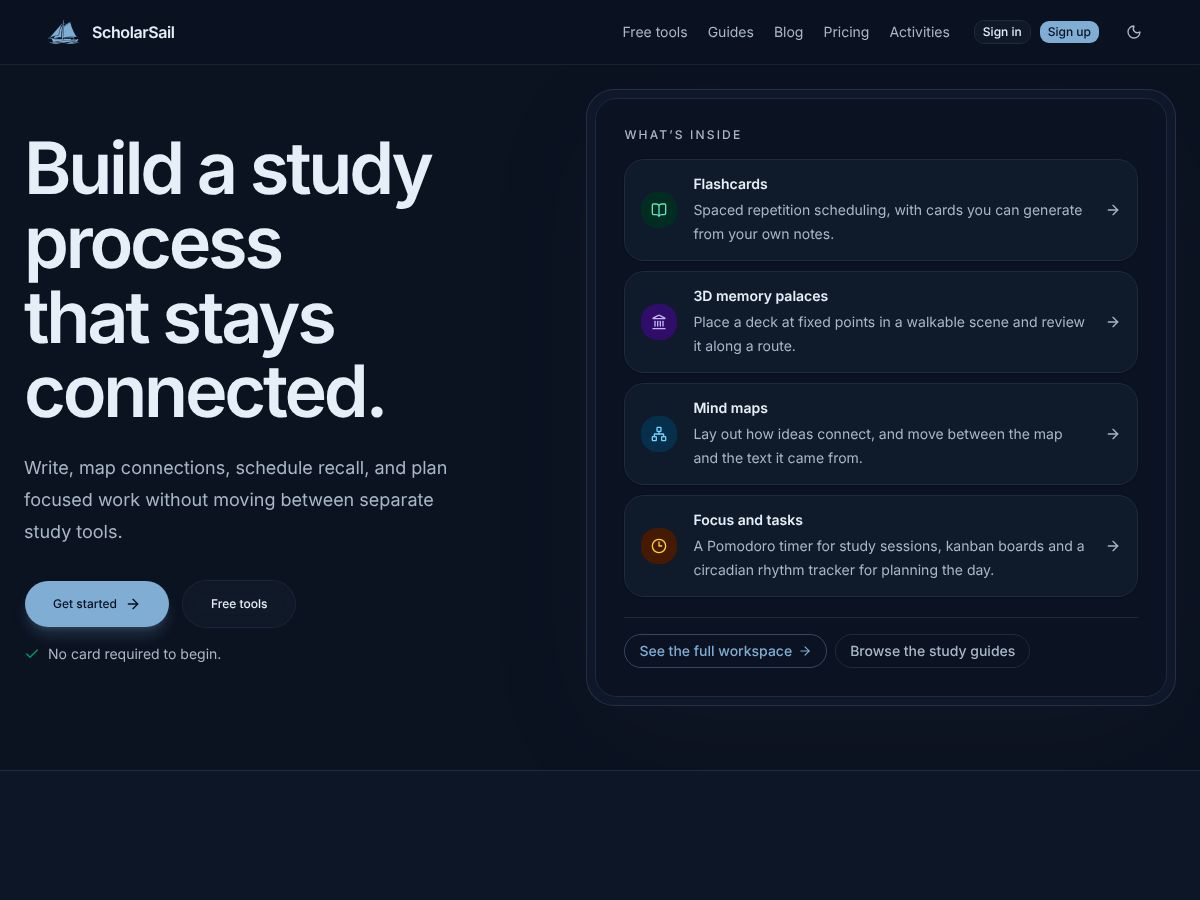
ScholarSail is an integrated study workspace that keeps four things most students juggle across separate apps in one place: spaced-repetition flashcards, 3D memory palaces, mind maps, and focus and task planning. The pitch is not that any single tool is the best of its kind, but that the material you read, the structure you give it, and the recall practice that follows all stay connected instead of scattered across a note app, a flashcard app, and a to-do list.
What ScholarSail does differently
Most study stacks break the link between source and recall. You read a chapter in one app, rebuild the ideas in a second, then retype them as flashcards in a third, and by the third step the original context is gone. ScholarSail's design goal is continuity: a mind map can be traced back to the text it came from, and a deck can be dropped into a spatial route without leaving the workspace.
Flashcards and spaced repetition
You can build cards by hand, import existing decks by CSV, or generate them from your own notes with AI, producing both front-and-back and cloze-deletion cards. Reviews are then scheduled with spaced repetition so cards resurface as you are about to forget them. The free plan allows unlimited decks and cards, so the ceiling is on AI generation rather than on how much you study.
3D memory palaces
This is ScholarSail's most distinctive feature. You place flashcard decks at fixed points along a route inside a walkable 3D scene, then review them in order using the method of loci. Ordered, spatial material (anatomy sequences, process steps, vocabulary sets, speech outlines) benefits most. Memory palaces are genuinely effective for ordered lists, though they add setup overhead that plain spaced repetition does not, so they are worth the effort selectively rather than for every deck.
Mind maps tied to the source text
Mind maps lay out how ideas connect on an open canvas, with the ability to move between the map and the underlying text. That link is the point: an outline that stays attached to its source stays correctable, which is where standalone diagramming tools tend to drift away from the material.
Focus and planning tools
- Pomodoro timer with saved session history, so study time is measured rather than estimated
- Kanban boards with task dependencies for sequencing coursework
- Circadian rhythm tracker for scheduling demanding work when you are actually alert
- Colored noise and binaural beats for focus audio during sessions
- Read Flow browser extension for bionic reading on pages outside the app
ScholarSail pricing
ScholarSail is freemium and needs no card to start. The free plan includes unlimited decks and cards, unlimited memory palaces, the Pomodoro timer with session history, CSV import and export, Word export, email review reminders, and 30 AI credits per month. Premium costs $20 per month and raises that to 1,000 AI credits per month on a higher-quality generation model. One-off credit packs are also sold at $1 for 50 credits (an intro pack, one per account) and $5 for 150 credits, and pack credits stay valid for 12 months and are spent only after the monthly allowance runs out.
How it compares to dedicated tools
On flashcards alone, Anki remains more mature: a larger shared-deck ecosystem, a deeper add-on library, and a more tunable scheduling algorithm. Dedicated mind-mapping tools offer more layout control, and dedicated task managers do more than a kanban board with dependencies. ScholarSail's argument is consolidation, not feature-by-feature superiority. If you already run a study system you like across several apps, the case for switching is weaker. If you lose time moving material between tools, that is exactly the friction this is built to remove.
Who it suits
It fits students and self-learners studying dense, structured material where understanding and memorisation both matter: medical and biology coursework, law, languages, and exam revision with a fixed date. It is a weaker fit if you only need flashcards (Anki is free and stronger) or if your subject is primarily problem-solving practice, such as mathematics, where worked repetition matters more than recall scheduling.
One credibility marker worth noting: ScholarSail publishes a study-guide library explaining the methods behind each feature, including spaced repetition, the method of loci, and concept mapping, and it states the limits of the supporting evidence rather than overselling the research. That is unusually candid for a study app.
Capabilities
Key Features
AI-powered flashcard generation from notes and text
3D memory palaces with spatial recall routes
Mind maps linked to source material
Pomodoro timer and circadian rhythm tracker
Kanban boards with task dependencies
Read Flow browser extension for bionic reading
FAQ
Frequently Asked Questions
Yes. ScholarSail lets you create flashcards manually, import existing decks by CSV, or generate front-and-back and cloze cards from your own text using AI. Cards are then scheduled using spaced repetition.
Memory palaces are walkable 3D scenes where you place flashcard decks at fixed points along a route. You review the cards in order as you move through the scene, combining spatial encoding with active recall. They work best for ordered material such as process steps, anatomy sequences, or speech outlines.
Mind maps let you lay out how ideas connect on an online canvas, and you can move between the map and the text it came from. That keeps the structure you build attached to the source material instead of drifting away from it.
ScholarSail is freemium. The free plan costs nothing and includes unlimited decks and cards, unlimited memory palaces, the Pomodoro timer, CSV import and export, Word export, and 30 AI credits per month. Premium is $20 per month for 1,000 AI credits and a higher-quality card-generation model. One-off credit packs cost $1 for 50 credits and $5 for 150 credits.
Yes. There is a free plan with no card required to begin, and it is not time-limited. Decks, cards, and memory palaces are unlimited on the free tier. The only free-plan limit is 30 AI credits per month for AI-generated flashcards.
AI credits are spent when you generate flashcards from text with AI. The free plan includes 30 per month and Premium includes 1,000 per month. Manual card creation, CSV imports, memory palaces, and mind maps do not consume credits, so you only need more if you generate cards from notes in bulk.
For flashcards alone, Anki is more mature, with a larger shared-deck library, more add-ons, and a more tunable scheduler. ScholarSail's advantage is that flashcards, mind maps, memory palaces, and focus tools live in one workspace with the source material, so you are not exporting between apps. Choose Anki for depth in spaced repetition, and ScholarSail if the switching cost between separate study tools is what slows you down.
Yes. ScholarSail supports CSV import and export for decks on the free plan, so you can bring in existing cards or take them elsewhere. Documents can also be exported to Word.
Community
User Reviews
Related